 |
 |
a Quantum Solar Energy Linz, Austria
bLinz Institute for Organic Solar Cells, Physical Chemistry,
Johannes Kepler University of Linz, Austria
Polymer photovoltaics offer great technological potential as a renewable,
alternative source for electrical energy. The demand for inexpensive renewable energy sources
is the driving force to new approaches in the production of low cost polymer photovoltaic
devices. In the last couple of years, enhanced efforts have been put into the development of
solar cells based on organic molecules and conjugated polymers [1-8].
Thus far, the efficiency of polymer solar cells under AM1.5 illumination has been increased
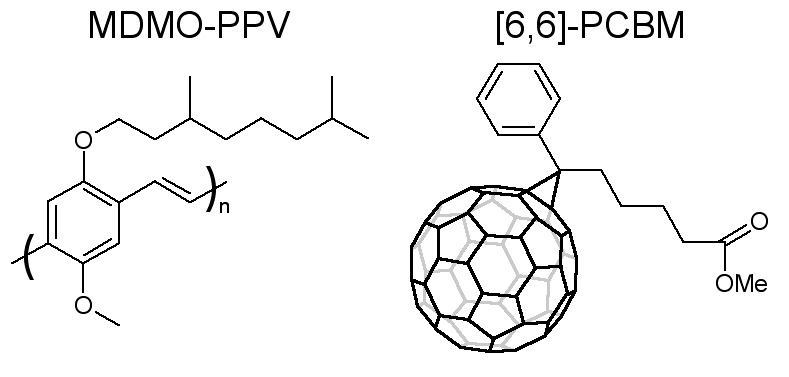
to >2.5 % [9], utilizing a soluble poly-(phenylene vinylene) derivative as hole
conductor and a methanofullerene as electron conductor. Although 2.5 % is a very promising
value for an all organic system, one of the deficiencies of these systems is the rather poor
stability under atmospheric conditions. The utilization of all organic photovoltaic devices needs
at least lifetimes in the order of several thousand working hours for an industrial application.
|
|
To achieve this life time at least two problems have to be solved. Due to the
influence of atmospheric environment (oxygen and/or moisture) on the MDMO-PPV a gas tight
sealing technique of plastic solar cells is necessary. On the other hand the influence of electrical
current , temperature and light has to be investigated under inert gas atmosphere to exclude
atmospheric influence for an understanding and consecutively a prevention of aging effects.
In our work we investigate the degradation behaviour of bulk heterojunction polymer /
fullerene based photovoltaic devices under inert gas atmosphereon a 100 h time scale. To study
changes in the behaviour of current-voltage (IV) - curves under electrical stressing as well as
the temperature under illumination conditions we investigated the degradation process
systematically under argon atmosphere. Furthermore different thermal treatments to single
layers of plastic solar cells were performed during the production process and the top electrodes
were exchanged to monitor their influence on the degradation.
AFM studies were made to detect the influence of the morphology on the efficiency as well
as on the life time of plastic solar cells. The smoothness/roughness of the surface of the
PEDOT:PSS film and of the PPV:PCBM film gives information on the proper choice of the
solvent, temperature treatment and phase separation.
References

email: franz.padinger@jk.uni- linz.ac.at