 |
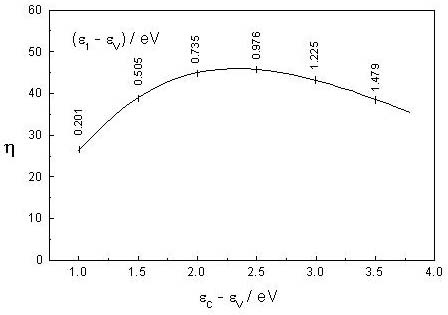
| Fig 1 Efficiency h as a function of the band gap _C ?_V for AM0 radiation for materials containing impurities with a single optimised level at _1. |
Universität Karlsruhe
D-76128 Karlsruhe, Germany
Impurities with energy levels somewhere in between the valence and
conduction bands of a semiconductor can provide additional stepwise transitions from the
valence to the conduction band by the subsequent absorption of two or more photons with
energies less than the band gap. This was first recognised by M.Wolf [1], who found a great
improvement in the efficiency of solar cells by the incorporation of impurities. His calculations
are, however, too optimistic. They use a constant minority carrier lifetime irrespective of the
presence of impurities. This approach violates microscopic reversibility since it makes use of
carrier generation via impurity transitions but disregards recombination mediated by
impurities.
Our calculation is based on radiative transitions only. It shows that the generation rate of
electron-hole pairs is increased by additional impurity transitions but that the recombination
rate is increased as well. Although the recombination is assumed to be entirely radiative, the
theoretical efficiency of materials with band gaps below 1.2 eV decreases due to the
presence of impurities. For larger band gaps, however, the theoretical efficiency is improved
by impurity transitions and large band gap materials become attractive for solar cells. In our
calculation optimal use is made of the incident spectrum. For one impurity level at energy
e1 all photons with energy e1 ó e V <
hn < eC ó e1 are assigned to the transition from the valence band
to the impurity level, all photons with energy eC ó
e1 < hn < eC ó eV are
assigned to the transition from the impurity level to the conduction band and photons with
hn > eCó eV are assigned to band-band transitions. Fig. 1 shows
the efficiency as a function of the band gap for an optimal value of a single impurity level. A
maximal efficiency of 46% is found for a band gap of 2.3 eV and an impurity level at
e1 = 0.88 eV above the valence band.
|
| Fig 1 Efficiency h as a function of the band gap _C ?_V for AM0 radiation for materials containing impurities with a single optimised level at _1. |
Wolf [1] suggested that the efficiency may be improved
even more by introducing more than one impurity level. He assumes an absorptivity of
a = 1 for each transition. For a transition from the valence band into the impurity this
would require that the impurity is almost empty. For a transition from the impurity into the
conduction band, however, the impurity should almost be fully occupied. The optimal
situation for the absorption of all potentially absorbable photons is achieved if one half of the
impurity states at each energy level is occupied and one half is empty, allowing transitions
into the impurity state and out of the impurity state with equal probability. With a single
impurity level this condition can be realised by proper doping. Charge neutrality ensures that
the occupation of the impurity state will not change markedly by illumination.
The occupation of impurities is different if more than one impurity level is present. The
lower energy level will always be more strongly occupied than the higher energy level, even
under illumination. The absorption properties are in general quite different for different
transitions. If small absorption coefficients are compensated by a larger thickness of the
material, total absorption of all absorbable photons can be achieved. For two impurity levels
a maximal efficiency of 50.3% is found for a bandgap of 3 eV and impurity levels at e1 = 0.46 eV and at e2 = 1.44 eV. For impurity concentrations of
2·1018 / cm3, however, the absorption coefficient of some
transitions is so small that total absorption requires an unrealistic thickness of 1 cm.
For a more realistic thickness of 100 µm, the maximal efficiency for two impurity
levels with a concentration of 2·1018 / cm3 each, is only
34.7% and is found for a bandgap of 2.0 eV and impurity levels at e1 = 0.39 eV and at e2 = 0.78 eV. This is a much smaller efficiency than
found for one impurity level where the same concentration results in total absorption for a
thickness of only 10 µm.
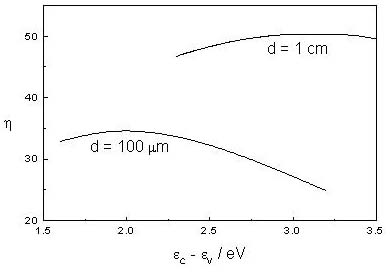 |
| Fig. 2 Efficiency h for AM0-radiation and radiative transitions involving two impurity levels |
We can conclude that a single impurity level may improve the efficiency of solar cells, but more than one impurity level is unfavourable. This is even more so if non-radiative transitions are considered which are more likely if more different energy levels are available.
References
| [1] | M. Wolf, Proc. IRE, 48 (1960) 1246 |

email: peter.wuerfel@phys.uni-karlsruhe.de